request a callback
+91 93194 38451
+91 89487 18876
Monday - saturday
10AM - 07PM
H-106, Block-H, Sector 63
Noida, Uttar Pradesh
request a callback
+91 93194 38451
+91 89487 18876
Monday - saturday
10AM - 07PM
H-106, Block-H, Sector 63
Noida, Uttar Pradesh
Expert Scheme X certification support to ensure seamless compliance with Indian safety standards.
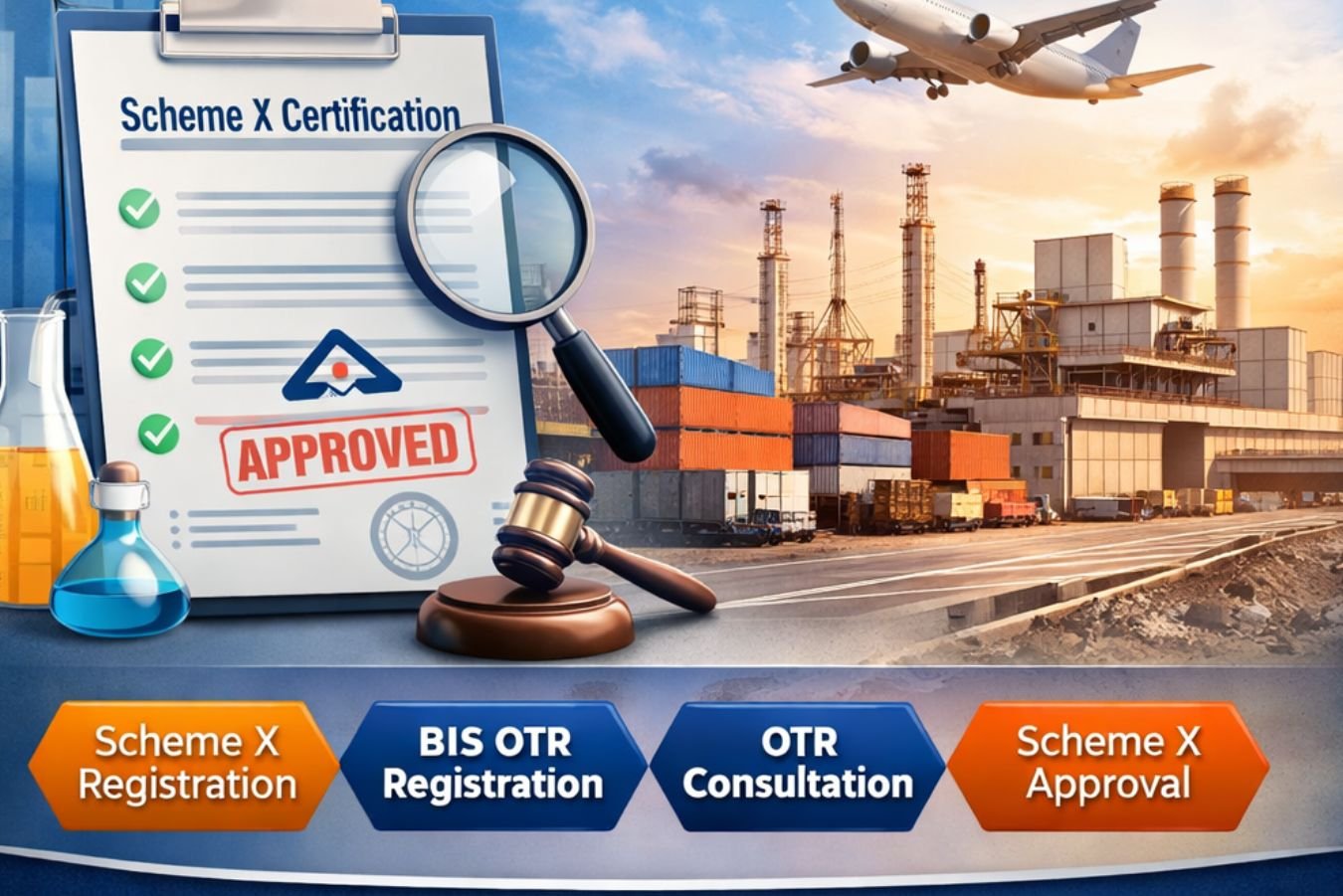
On March 16, 2022, the Indian Bureau of Standards (BIS) introduced "Scheme X". It aims to allow both domestic and foreign manufacturers to have all sorts of assemblies/sub-assemblies/machine tools under Schedule-II, Scheme-X certified with the BIS Scheme X mark, which is necessary before they can be sold in the Indian market.
BIS Scheme-X the license or Certificate of Conformity (COC) for low voltage switchgear and control gear, Machinery, and Electrical equipment, which are issued under Scheme-X, that the manufacturer can affix the BIS Standard Mark on their product.
The products certified under Scheme X retain the Indian standards and regulations set forth by the Government that are relevant, deeming them to be adequate measures of trust for consumers.
Scheme X, which is a product certification scheme, was launched as part of the Bureau of Indian Standards Conformity Assessment Regulations, 2018, and was further refined by the BIS Conformity Assessment (Amendment) Regulations, 2022. This process leads to Scheme X certification.
Its primary aim is the harmonization of Indian safety standards with global standards. Under this scheme, machinery and electrical equipment that are either manufactured or imported within India are certified under Scheme X to comply with the mandate of rigorous technical and safety standards.
The order, which is referred to as the Machinery and Electrical Equipment Safety Order, 2024,represents the Omnibus Technical Regulation released through the Ministry of Heavy Industries via a notification for its publication on August 28, 2024. This order is a crucial BIS Scheme X QCO (Quality Control Order).
The primary purpose of the Omnibus Technical Regulation is the implementation of the machinery and electrical equipment assemblies compliance systems and safety directives, along with the applicability of components under Scheme X of the BIS Conformity Assessment Regulation.
This directive pertains to all types of machinery or electrical equipment, including their assemblies, sub-assemblies, or any other parts thereof, but subject to varying exclusions set forth below:
In brief, all the machinery and electrical equipment outlined in the Omnibus Technical Regulation 2024, as well as the low voltage switchgear and control gear notified by the Ministry of Heavy Industries, shall be under the Saw Certification Scheme X of the Bureau of Indian Standards.
Scheme X is the set of rules for all products that need to follow particular technical expectations as mentioned in India Standards. Different from the other BIS schemes, scheme X provides manufacturers with the option of:
Such flexibility considerably helps the industry by producing high-quality products at their discretion while adhering to marital standards.
The Bureau of Indian Standards (BIS) is the authority that grants BIS certification for products that are under Scheme X. The BIS Standard Mark or mark Certification Scheme X B is the license number of the product shown at the bottom as 'CM/L-XXXXXXXXXX' while the standard number is shown at the top of the mark.
This mark is issued by the Bureau of Indian Standards only after the successful issuance of the BIS License. All manufacturers shall follow the norms specified in the Indian Standards and have their products marketed with the corresponding BIS Mark.
Marking and selling any product in the Indian consumer market with a license number 'CM/L-XXXXXXXXXXXX' without obtaining a BIS license is a punishable offense.
Know about the various products covered under Scheme X. This scheme is for products that have the highest risk and are defined as, for example, low voltage switchgear and controlgear :
Electrical Equipment
Industrial Transformers, Power Supply Units, and High Voltage Equipment.
Heavy Machinery
Hydraulic Presses, Industrial Cranes, and Automation Equipment.
Safety Equipment
Fire Extinguishers, Pressure Vessels, and Emergency Electrical Systems.
Specialized Consumer Electronics
Medical Grade Electrical Appliances that have prominent safety features.
If your products are similar to any of the ones mentioned above then you are a manufacturer who has to get the Scheme X certification first before you can start the manufacturing and selling of your products in India.
The manufacturers must have the following documents to obtain BIS certification for Machinery and Electrical Equipment from BIS
| Sl. No | Required Documents | Details |
| 1 | Name, Address (Factory & Office) | Manufacturer's registered name and complete address of both factory and office. |
| 2 | PAN, GST details | Permanent Account Number (PAN) and Goods and Services Tax (GST) registration details. |
| 3 | Contact details | Email, phone number, and office contact number of the manufacturer. |
| 4 | Details of the management and authorized person | Names and designations of key management personnel and authorized signatory. |
| 5 | Details of the machinery and electrical equipment to be registered | Equipment details as per the First Schedule of the OTR. |
| 6 | Name/type and variety of products | Specific name, type, and variety of products for which BIS certification is sought. |
The following steps spell out the obtaining BIS certification under Scheme X process:
Identify if the BIS safety requirements apply to your product and if it is covered by Scheme-X.
This includes documents such as Business Registration, Product Specifications, Factory Layout, and Test Reports.
A compliance report is prepared in support of the technical file along with the product and demonstrates that the product has been statistically proven to meet the prescribed standards. The technical file is to include product information, manufacturing processes, compliance documents, product scope, and quality check documents, and other pertinent information showing traceability. If necessary, it may provide testing, raw materials and sub-contract agreements, and confirmations of tests.
The submission of the application is done via the BIS portal and the respective fee is paid.
The time period for inspecting a domestic manufacturer’s factory is 2 days, and for a foreign manufacturer, it is 3 days. Extra requests, if any, will be needed over and beyond additional days. The visit involves the BIS officials monitoring the manufacturing methods and quality assurance systems in use meticulously, going through the technical file, witnessing tests, checking for non-conformities or providing advice, and reporting to the applicant. The auditor shows the applicant all the findings at the end of the audit.
The product sample tests are conducted either at the manufacturing unit or by the BIS accredited laboratories if any test is outsourced.
BIS shall grant a license to use the BIS mark if the stipulated conditions are met.
The following steps will take place for Domestic Manufacturers mentioned below:
Documentation Process
Submission of Application along with Application Fee
Application recording by BIS
Scrutiny of Application and response to any queries raised by BIS
Nomination of Auditor & Payment to BIS (Audit charges)
Factory Audit and Sample sending for Testing at OSL
Testing of samples in BIS recognized lab & Payment to Laboratory for Testing (Sub contracted facilities may vary.)
Payment to BIS (Marking fee and licence fee)
Grant of License
General Timeline: approx 90 working days as per BIS practice
The following steps will take place for Domestic Manufacturers mentioned below:
Documentation Process
Submission of Application along with Application Fee
Application recording by BIS
Scrutiny of Application and response to any queries raised by BIS
Nomination of Auditor & Payment to BIS (Audit charges)
Audit preparation (including arrangements for Visa, Air tickets, Hotel Booking)
Audit preparation (including arrangements for Visa, Air tickets, Hotel Booking)
Testing of samples in BIS recognized lab & Payment to Laboratory for Testing (Sub contracted facilities may vary.)
Payment to BIS (Marking fee and licence fee)
Grant of License
General Timeline: Approx. 6-7 months, based on current practices.
Here are some supplementary tips for foreign manufacturers:
As per FMCS norms, all foreign manufacturers, regardless of their actual scale of operations, fall under the category of large-scale.
To ensure the smooth operation and maintenance of the BIS license, foreign manufacturers must appoint an AIR (Authorized Indian Representative) who is responsible for the acts as a liaison.
Factory audits for foreign manufacturers are a combination of on-site inspections and sample testing at BIS-recognized labs. They usually last for 3 days with additional man-days for each extra application.
To enhance efficiency in the Scheme X certification process, manufacturers would have to follow the prescribed fee structure. The following fee structure has been notified by the Bureau in accordance with Schedule-II, Scheme-X, Paragraph 5 of the Bureau of Indian Standards (Conformity Assessment) Regulations, 2018. This notification will be applicable to those products or product groups, which do not have any specific fee mentioned separately.
| S.No. | Fee Component | Approx. Amount |
| 1 | Application Fee for Grant of License | ₹2,000 |
| 2 | Application Fee for Certificate of Conformity | ₹2,000 |
| 3 | Certification Fee for License Grant or Renewal | ₹25,000 per year |
| 4 | Certification Fee for Certificate of Conformity | ₹10,000 |
| 5 | Technical File Review Fee (for license, certificate, or scope changes) | ₹20,000 per technical file |
| 6 | Inspection Fees (Including Surveillance) | ₹20,000 per man-day |
| 7 | Sample Procurement Charges | Based on actual costs |
| 8 | Testing Charges | Based on actual costs |
The BIS Scheme X Certification has a lot of advantages for business manufacturers and consumers. Here are the main ones:
Assuring your products conform to Indian standards helps you avoid legal issues and penalties
It is easier to enter into the Indian market with BIS certification as many buyers require it.
By following strict guidelines, it can avoid the risk of product recalls which will be costly.
In particular, being certified can be a powerful strategy to have products stand out from other similar products in the market.
It increases the trust in quality and safety of the product,thereby, increasing both sales and brand reputation.
Prolix India is a reliable partner for BIS Scheme X Certification, providing complete assistance from start to end to attain an easy and hassle-free approval process. We have thorough knowledge of BIS regulations and thus facilitate the documentation, product testing,application submission, and factory inspections that are necessary to comply with the Indian standards fully.
The very good relationship that we maintain with the BIS Authorities enables us to help with the approval prior to time and to reduce the time of waiting significantly. We offer industry-specific cost-effective solutions that fit the needs of a variety of sectors such as electronics, IT, automotive, and consumer goods. Opting for Prolix India is the key to a simple, clear, and fast certification process, and thus your products can easily enter the Indian market.
BIS Scheme X certification is essential for ensuring quality and safety of low voltage switchgear, control gear, machinery, and electrical equipment. Scheme X allows the manufacturer to simplify the production process and conform to stringent Indian standards.
BIS Scheme-X certification is needed for machine tools of stone, ceramic, concrete, cement, and mineral glass products. Compliance with these regulations will ensure the reliability of the product and at the same time, will gain more trust from the customers on the brands that have been certified.
BIS Scheme-X certification consultant, Aleph India, eliminates procedural complexities for the certification. With its long-standing experience in being the trusted manufacturer partner in India for 16 years, Aleph India is a BIS consultant. Along with its background in product testing, inspection, and regulatory compliance, Aleph India has the ability to give a total package of help to manufacturers and importers.
BIS Scheme X is a certification program that comes under the BIS Conformity Assessment Regulations, 2022, which is meant to ensure that machinery and electrical equipment are in compliance with very strict safety and technical standards.
The product is a necessity that is in line with Indian safety requirements, boosts the credibility of the product, and is obligatory for application in machinery and electrical equipment under the Omnibus Technical Regulation.
The certification is relevant to devices such as pumps, compressors, cranes, transformers, switchgear, generators, and other types of electrical and mechanical equipment that are specified in the regulation.
This certification must be obtained by both domestic and foreign manufacturers of machinery and electrical equipment intended to be sold in India.
These are the essential documents that are needed to include manufacturing details, test reports, quality control procedures, factory layout, and proof of business registration.